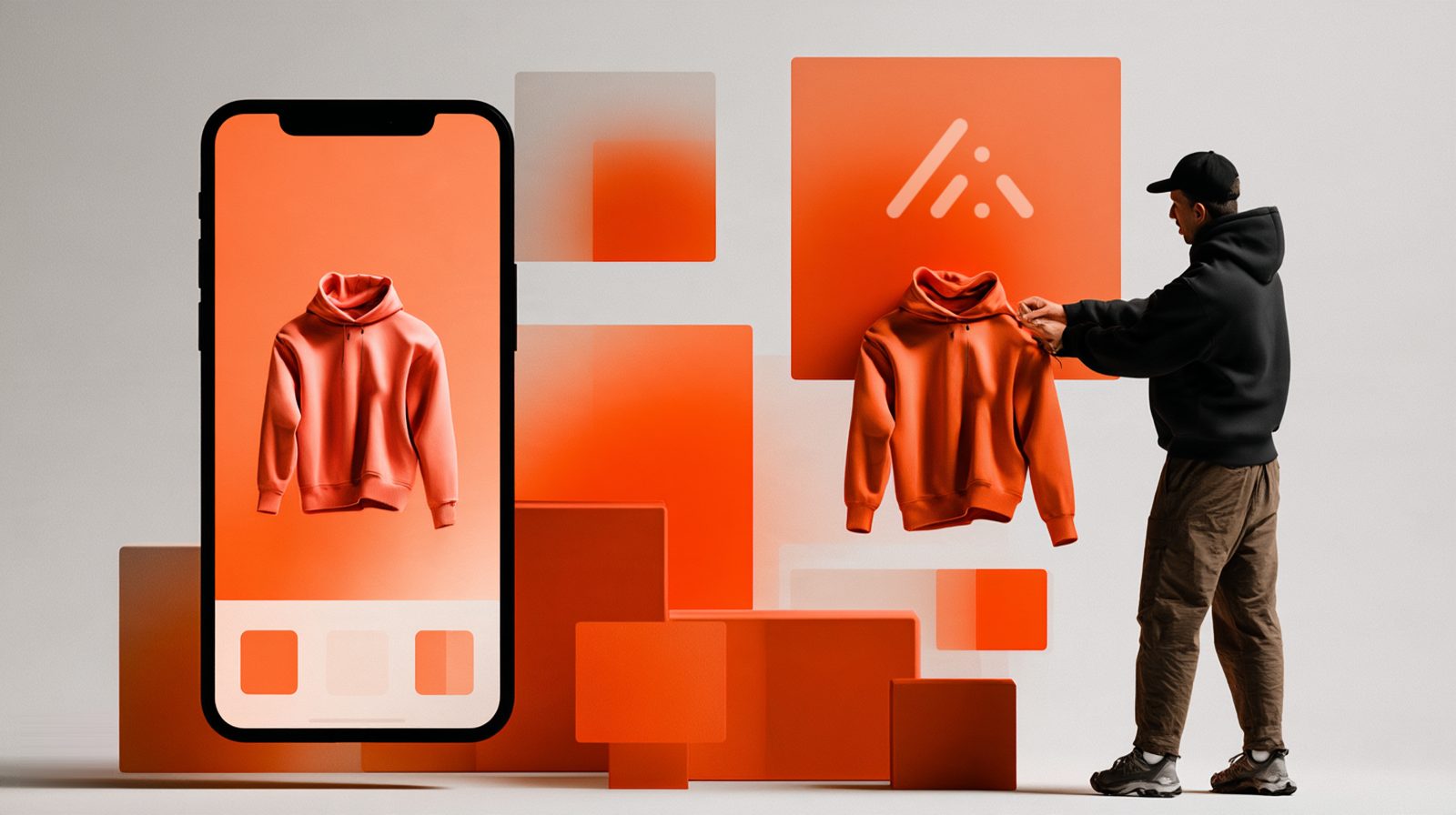
Quick answer
Digital fabric and material digitization turns a physical fabric into data that 3D design, product communication and production can all work from. In practice that means two things: capturing how the material looks, as textures, images and video, and measuring its color as a standard. Today's digital fabric twins handle the first part well, but no texture format carries a color standard, so the render and the dye house end up with two references for one color. Digitization pays off once both halves live on one platform, under one standard, with tolerances every supplier measures against.
Approved on screen, rejected in bulk
Your fabric was scanned, the texture loaded cleanly into your 3D fashion design tool, and the style passed line review on screen. Weeks later the bulk arrives, and next to the approved render the color reads differently. Slightly warmer, slightly flatter, but enough for someone to say "this is not what we signed off."
Then the search for the mistake begins, and it rarely finds one. Your scan was clean, your render was correct, and the mill can show the lab dip that passed against the reference it received.
If every step was right and the outcome is still wrong, look at what each step handed to the next.
Inside a digital fabric twin
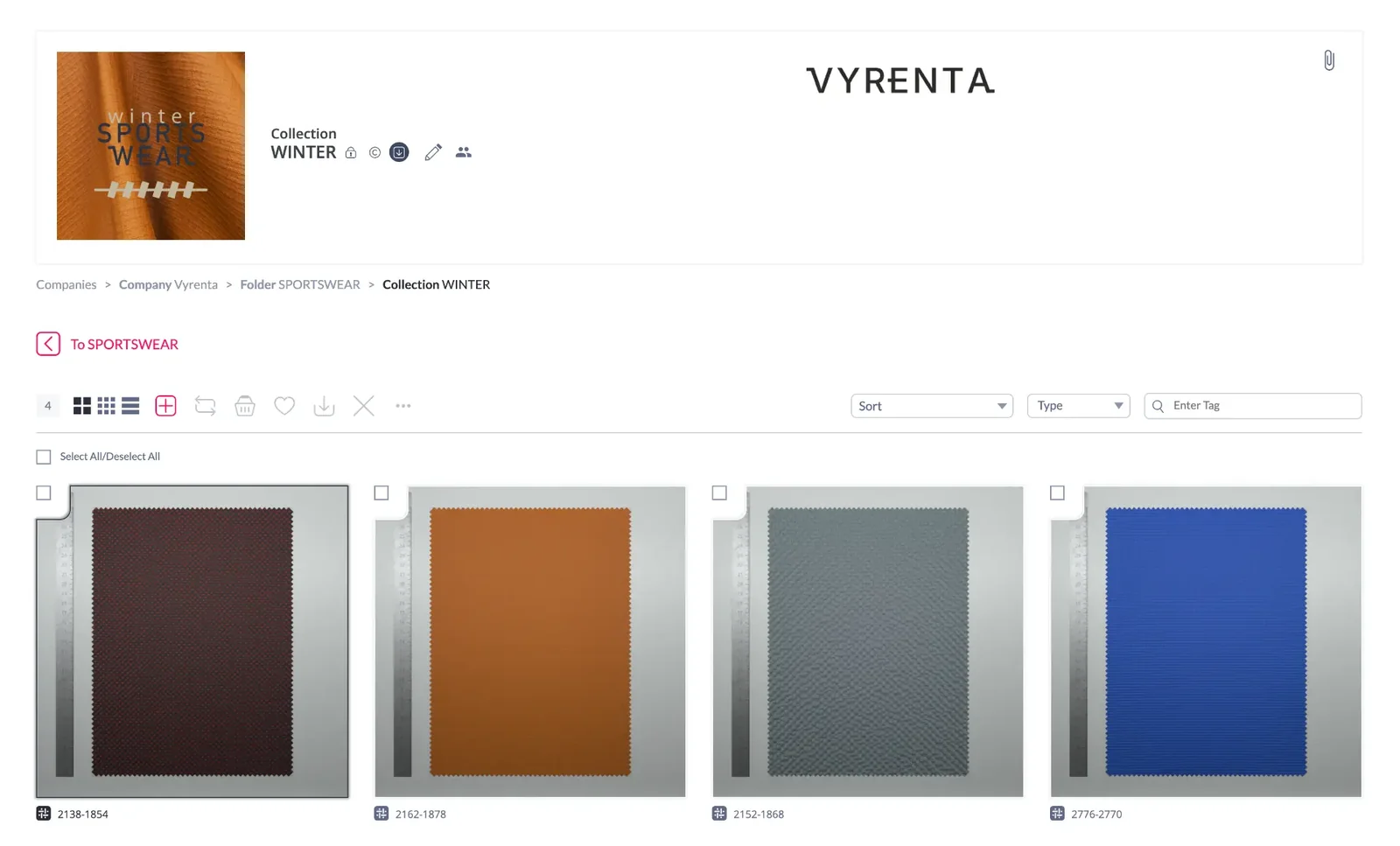
Digital fabric twins are built to make a material look right under virtual light. A good one carries a full set of texture maps (base color, normal, gloss or roughness, displacement, alpha), standardized images under controlled lighting and, ideally, a video of how the fabric drapes and moves. That is exactly the information 3D design needs.
Color sits in the base color map, which is an RGB image, and RGB is a recipe for a screen. Such a map records how the fabric looked under one light, captured by one setup, prepared for a renderer. Nothing in the file says how that color behaves when the light changes, and two colors can match under one light source and drift apart under another.
No texture format carries a color standard. This holds for every scanner and every 3D tool, because it follows from what the formats are for: a PBR texture set describes appearance, it does not specify color.
Two references, both reasonable
From here, the color decision forks. Design and the 3D team work from the twin, while the mill works from a physical standard, a lab dip or a value in a spec sheet, judged in its own light booth. Both sides use the best reference available to them, and neither is wrong to do so.
Trouble starts when a decision made against one reference is executed against another. Designers approve a render, dye houses match a swatch, quality checks the bulk against whatever arrived last. Across an apparel supply chain that spans several companies and time zones, every handover becomes a small translation, and translations add up.
So approval rounds keep multiplying, even in teams that have invested heavily in 3D. Approval loops are not a sign of slow teams. They are a signal that decisions rest on a foundation that cannot carry them.
Two halves, one standard
Material digitization works when appearance and color are treated as two halves of the same material, and the color half gets a single reference: the standard.
Think of the twin as showing what the material looks like, and the standard as saying what the color is. Because the standard is measured spectrally, meaning the color itself rather than its image on a screen, it can be retrieved and reproduced independently of the light it was viewed in.
No process clones a color, but every process can be controlled against one. Each material gets its own tolerance plus a defined direction the deviation may take, derived from what the final product demands: whites may go cooler, never yellower. A cotton jersey and a polyester trim will never hit exactly the same value. Governed against the same standard, they still look like they belong together.
Your eye makes the decision, in 3D or on the table. Measurement makes sure it arrives, whether the next person in line is a 3D artist on another continent or a dye house preparing its next lab dip.
Fabric and material digitization in DMIx
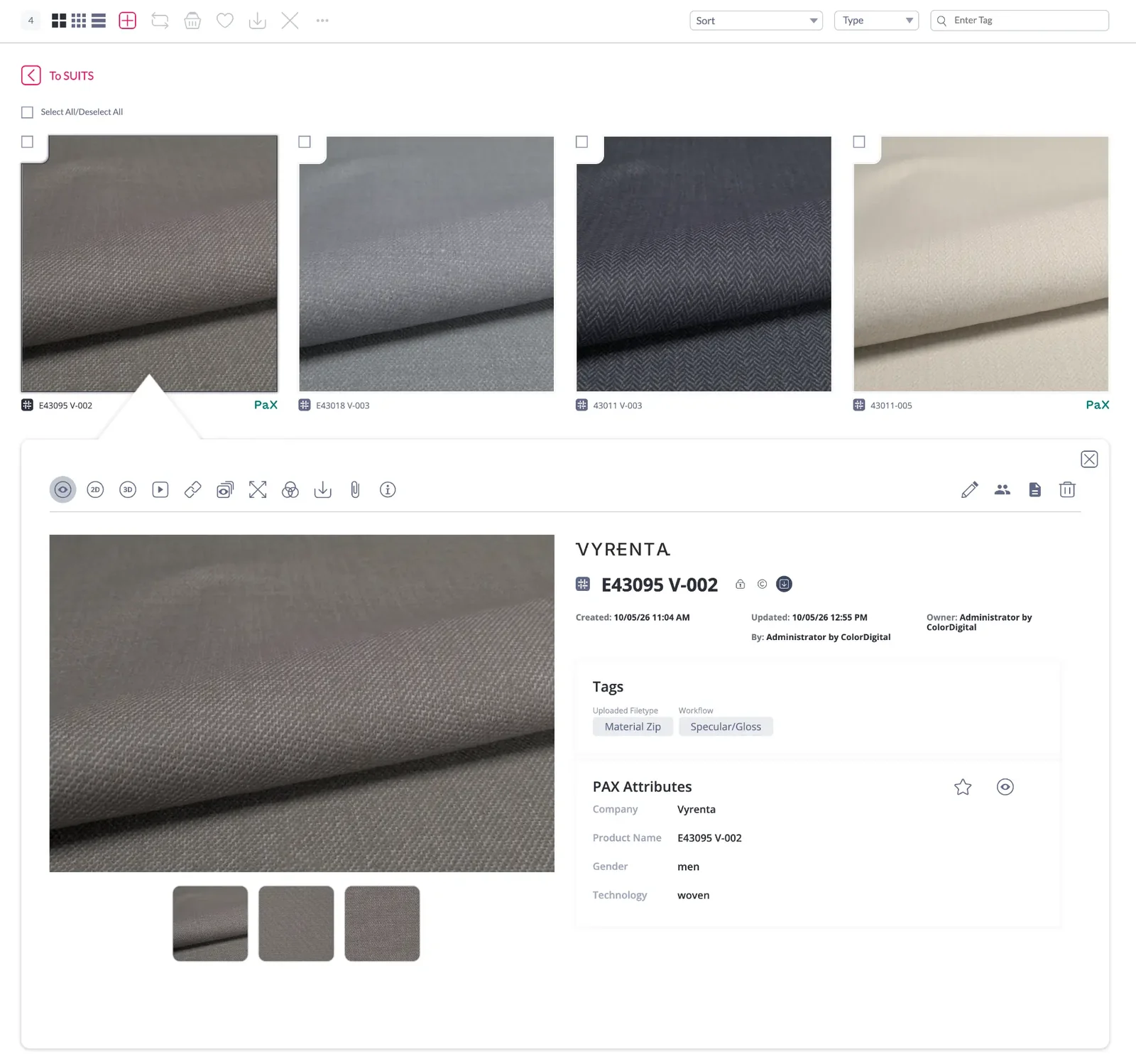
DMIx, the first Product Reality Management System (PRMS), keeps both halves of a material on one platform that brands and suppliers share. Appearance and color are each captured by the instrument built for them.
- Textile material scanning with SamplR. Paired with an iPhone, this controlled-light device captures a physical material as a standardized digital twin: a PBR texture set, images under four controlled lighting geometries and a behavior video for drape and hand feel. Each scan takes just over a minute and needs no cutting. Since operating it needs no 3D or color expertise, SamplR can sit at the mill or the warehouse while the 3D team pulls the finished material from the library.
- Measured color in the Color Managed Library. Color standards are measured with a spectrophotometer, brought in through MatchBox and stored as spectral data across the visible range from 400 to 700 nm. Industry color systems are held in the platform too, among them Pantone and Archroma.
- Heterogeneous materials. On melanges, prints and lace, a spectrophotometer sampling a 4 mm spot cannot give a meaningful reading. SamplR Color Measure (Beta) adds area-based, image-based colorimetry for exactly these materials.
- Tolerances every supplier works to. MatchBox compares each lab dip against the standard and returns a result against defined tolerances instead of an opinion. With Supplier Self Approval, the brand sets the spectral tolerances, trusted suppliers release in-tolerance lab dips immediately, and anything outside tolerance goes through standard review. In production, BulkControl checks fabric rolls left, center and right, with traffic-light feedback directly in the process.
- Straight into 3D. AppLink connects DMIx to CLO 3D and Browzwear, so materials are pulled into the scene by drag and drop instead of being rebuilt. Standard formats such as U3Ma, glTF and GLB, AxF, SBSAR and xTex handle the exchange with other tools.
- Tied to something you can order. Every material stays connected to its master data, such as article number and supplier.
What changes for brands and suppliers
Brand product development teams get one reference for the 3D choice and the production approval. Once the color behind a style is a measured standard rather than a texture value, line review, the mill's lab dips and the roll check in BulkControl all refer to that same standard. Fewer translations mean fewer rounds, and review meetings can move from "is this the right color" to "is this the right product." PVH Europe has worked with DMIx since 2019 and reports a 50 percent reduction in lead times in its digitized lab dip and bulk color workflows.
Suppliers gain a sales tool instead of one more request to fulfill. You can present a material without shipping a swatch, using standardized images, a behavior video and a PBR texture in place of the physical sample. Acceptance criteria are known before production starts: one standard, material-specific tolerances and a defined direction. And with measured evidence in hand, you can approach brands and win work on predictability, rather than waiting for the next round of comments.
Next steps
Start with one material family, not the whole archive. Scan it with SamplR, measure its colors as standards, agree tolerances with one supplier, and compare the result against the library texture your 3D team uses today. One season is enough to see whether render and bulk start to agree.
Visit the SamplR page to see how physical materials get into a library, or the Color Managed Library to see how measured color is stored and retrieved. If you are comparing platforms, the seven criteria for choosing a material library platform go one level deeper.
Want to try this on your own fabrics? Talk to us directly: we take 60 minutes, on your materials.
Frequently asked questions
- What is a digital fabric twin?
- Put simply, it is a standardized digital record of a physical fabric: PBR texture maps for 3D tools, images under controlled lighting and a video of how the material drapes. Designers, 3D artists and buyers can judge a material with it before a physical swatch arrives. Tied to a measured color standard and to its master data, it becomes a reference production can act on.
- How are textile materials scanned for 3D fashion design?
- Scanning happens in a controlled light environment, in a single session that takes just over a minute with SamplR. You get a PBR texture set for CLO 3D, Browzwear and other tools, plus standardized images and a behavior video. Color for production is measured separately with a spectrophotometer, so your 3D team gets the right appearance and the mill gets the right number.
- Does this fit into an existing PLM and 3D setup?
- Yes. As a PRMS rather than a PLM, DMIx connects to PLM and ERP through its API layer instead of replacing them, so color and material data do not become another silo. On the 3D side, AppLink brings materials into CLO 3D and Browzwear, and standard formats keep them usable in other tools. Exports in QTX, CxF and CSV mean color data can leave the system again.