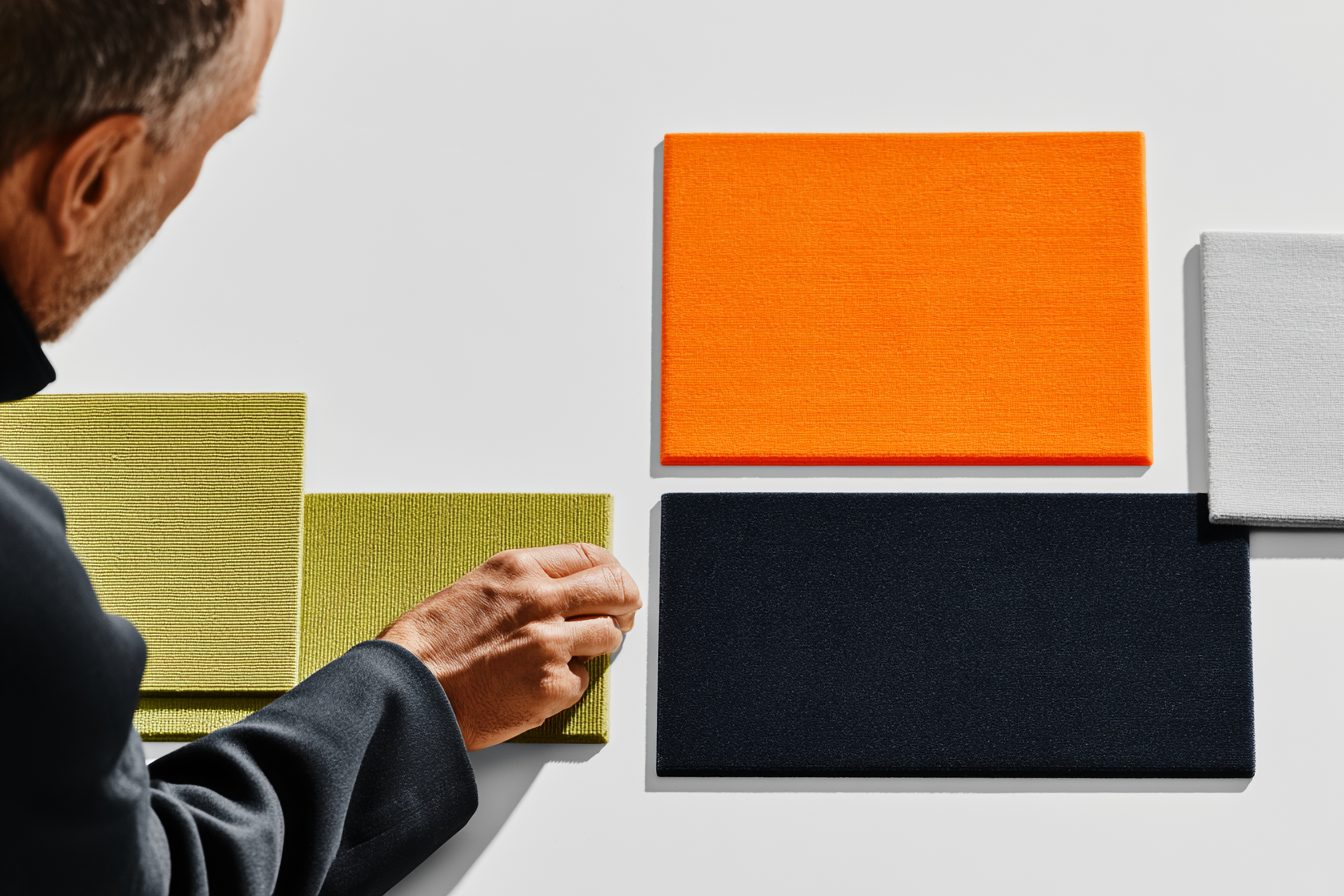
Every designer has sat through the pitch that data beats the eye. It never lands, and the resistance is not stubbornness. It is a sign that the argument is aimed at the wrong problem.
Quick answer
Color and logic keep talking past each other because the industry frames them as rivals: your trained eye on one side, measurement data on the other. That framing is wrong. The aesthetic decision is yours and stays yours. What fails is not the judgment but the journey: your approved color decays on its way through screens, light booths, aging references, and time zones. Logic is not there to overrule your eye. It is there to make sure your decision arrives.
The pitch you have heard a hundred times
You know the scene. Someone opens a slide deck and explains that human color perception is unreliable, that numbers do not argue, and that the sooner decisions are "data-driven," the better. The subtext is hard to miss: the thing you have spent years training, the eye that carries your signature through every collection, is the weak link.
And so the pitch fails. Not because the charts are wrong, but because they are aimed at you instead of at the problem. Nobody builds a career on color and then applauds an argument whose punchline is that their judgment should matter less.
Your resistance is rational
Here is what the logic-first crowd misses: in your world, the eye is not a measurement device with poor specs. It is the instrument that makes the decision in the first place. Whether a warm off-white feels calm or cheap, whether a red carries the collection or fights it: no instrument answers that. Aesthetic judgment is the craft, and defending it is not vanity. It is quality control for meaning.
So when a tool arrives promising to settle color questions with numbers, you hear a demotion. Rejecting that is not fear of technology. It is an accurate reading of a bad offer.
The real misalignment is not eye versus data
Now look at where color actually breaks. You approve a color at your desk or in the light booth. That decision then travels: to a screen that was never calibrated, into a booth with a different light source, past a physical reference that has been fading in a drawer for two years, through hand-offs across three time zones and half a dozen interpretations of "a touch warmer."
Nobody in that chain made a mistake. Everyone judged carefully with what they had. And still, the bulk delivery arrives and your first thought is: this is not the color I approved. Not because anyone overruled you, but because your decision arrived distorted. It played telephone across the supply chain, and telephone always wins.
This is the actual misalignment of color and logic. Color lives in human judgment. Logic lives in transmission. The industry keeps sending logic to fight judgment, when the only fight that matters is against the silent decay of your intent in transit.
What logic is actually for
Measurement does not judge a color. It transports one. Once your approved shade exists as measured data, spectrally captured, meaning the color itself rather than its image on any particular display, it stops depending on whose screen, whose booth, and whose memory it passes through. The mill in another hemisphere works against your decision, not against a copy of a copy of it.
The same goes for tolerances. A tolerance is not a machine second-guessing you. Done right, it is your decision written down as a rule, including the direction a deviation may take: this white may drift cooler, never yellower. That is a creative criterion, formalized so it survives the distance. You define it once. From then on, every judgment call downstream is anchored to your call, not to whatever reference happens to be lying around. That is exactly what digital color standards are for.
Nobody can clone color. No process reproduces a shade identically, and honest color work starts by admitting that. What can be done is control: one approved standard, your standard, and clearly directed room around it.
From creative decision to protected standard.
How DMIx protects the decision you already made
DMIx is built on this division of labor: your eye decides, the system carries the decision. In practice, that means your approved color lives in DMIx MatchBox as measured data, the single reference every partner works against, instead of drifting copies of it. Tolerances and their direction are set from your creative intent, and every downstream check happens against your approval rather than against local interpretation.
Two honest limits belong in this picture. Measurement discipline takes effort; it is a habit, not a switch. And color measurement does not always fully capture them in complex patterns, which is why the final aesthetic call on real material stays exactly where it belongs: with you.
Next steps
See MatchBox for how approved colors travel as data instead of courier packages, or read our post on digital color standards for how one reference holds across an entire supply chain.
Want to see what your own approved colors look like as protected decisions? Talk to us: 30 minutes, one of your color stories, your judgment intact.
Frequently asked questions
- Can you measure something as emotional as color?
- You can measure a color. You cannot measure whether it is the right color, and DMIx does not try. The aesthetic decision stays human. Measurement records the decision you made and carries it unchanged to everyone who has to reproduce it.
- Does color measurement replace the designer's eye?
- No, and any tool that claims it does should worry you. The eye makes the call. Measurement makes the call arrive. Without it, your judgment is exercised once and then reinterpreted at every step; with it, your judgment is the standard everyone works against.
- What about gloss, texture, and translucency?
- Color measurement does not always fully capture them in complex patterns. That is a real limit, worth naming. It is also why physical evaluation and the designer's final say remain part of a mature color process rather than being argued away.