
Quick answer
Workwear color consistency is solved with spectral data, not RGB or LAB alone. DMIx stores every shade as a spectral fingerprint, MatchBox enforces the tolerances, and suppliers work from the same source of truth.
Why workwear color consistency matters
Workwear is uniform. A jacket that ships from Vietnam in March must match the trousers from Tunisia in October, and both must match the next reorder two years later. Standard color values fall apart the moment lighting or fiber blend changes. Spectral color measurement closes that gap.
How DMIx safeguards color consistency
We safeguard color through three layers:
- Precise color measurement and a digital color archive, every shade stored as spectral data.
- Clear standards and defined tolerances that are binding for every stakeholder.
- The Color Control Module (MatchBox), which enforces those standards across the entire production chain.
Suppliers connect easily through the platform. Everyone sees the same target, and you receive consistent, reliable workwear.
Why spectral color measurement is crucial for workwear
Colors in workwear must be reliably reproducible, not just look acceptable. Spectral color measurement is the technical core of DMIx and the reason consistency becomes measurable.
What spectral color measurement means
Instead of storing only RGB or LAB values, a spectrophotometer measures how a material reflects light across the visible spectrum (about 400 to 700 nm). Every material gets its own color fingerprint.
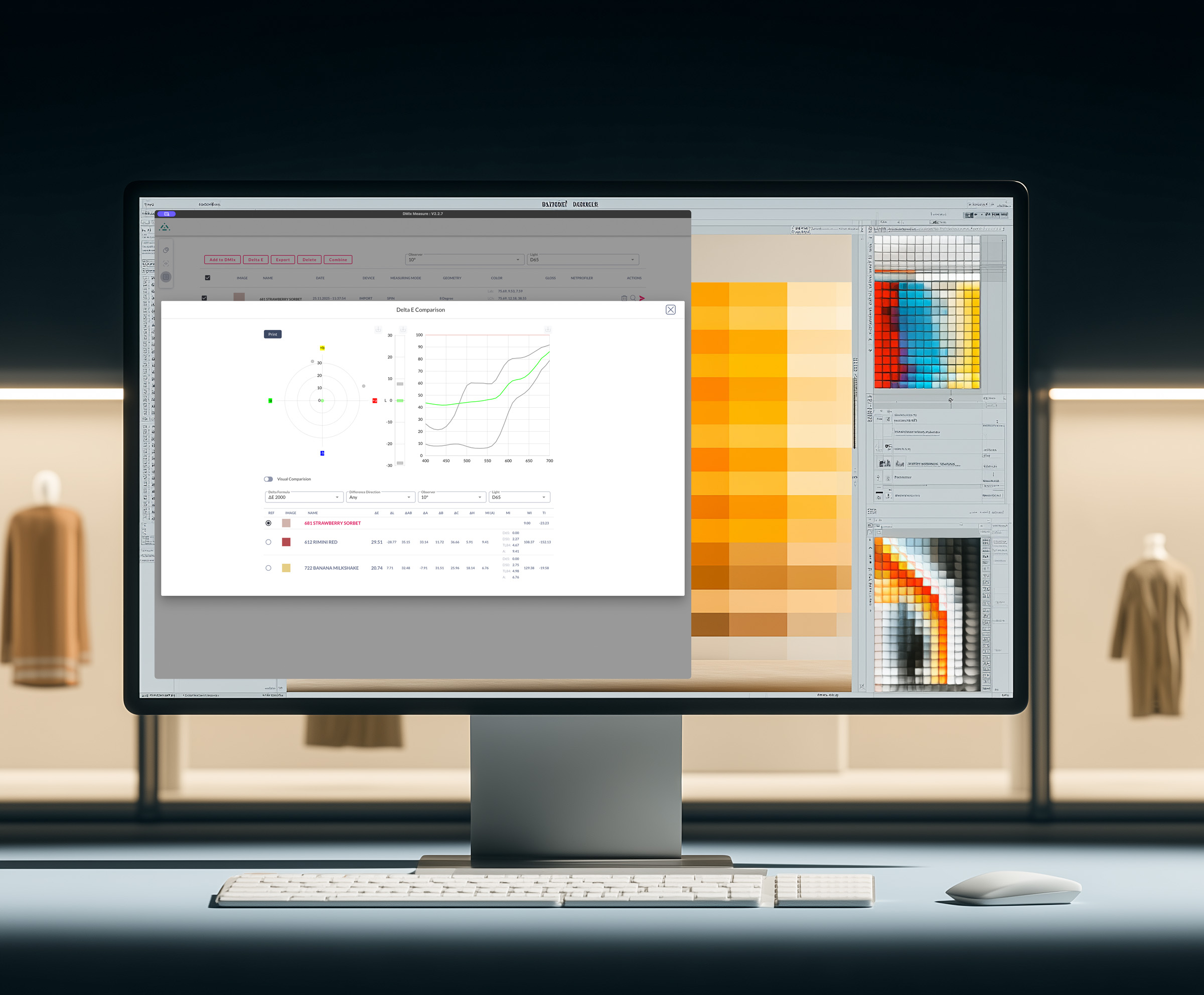
Why this matters in production
- Stable under any light: Standard color values fail when a jacket looks different in a warehouse, outdoors, or on the production floor. Spectral data stays defined.
- Material-aware: Cotton, polyester, and blends absorb dye differently. Spectral measurements detect those differences and make them comparable.
- Reproducible by suppliers: Suppliers see not just which color is meant, but how to produce it physically. Re-dyeing drops sharply.
- Objective, not subjective: No more debates about "too red" or "too green". The data decides, not the monitor.
How DMIx makes spectral data usable
- Digital color archive: every color stored as a spectral dataset.
- Standardized tolerances: DMIx defines the allowed deviation per shade automatically.
- Color control in production: MatchBox checks every dye process against the standard.
- Supplier integration: suppliers get immediate access to the same standards and instructions.
Next steps
Explore the MatchBox module for hands-on tolerance enforcement, or read A Standard is A Standard is A Standard for the full philosophy behind DMIx tolerances.
Frequently asked questions
- Why is workwear color consistency so hard to achieve?
- Different fibers absorb dye differently, lighting conditions vary, and suppliers often work from RGB or LAB only. Without spectral data, every batch becomes a negotiation.
- What does spectral color measurement actually do?
- A spectrophotometer measures how a material reflects light across the visible spectrum (about 400 to 700 nm). The result is a unique color fingerprint that holds up under any illumination.
- How does DMIx MatchBox enforce tolerances?
- MatchBox compares every dye lot against the spectral master, applies the defined tolerance window, and gives a pass or fail verdict your suppliers can act on instantly.